Any distraction will do…just keep busy

For a time, then, modern man was diverted by the free play of newly discovered powers in an expanding world.  The novelty of freedom for the growing powers of the individual distracted attention from the necessary implications of rationalism.  It was enough to seek freedom, and the first joy of being free made it seem unimportant to ask what freedom was for — save to assert that it was for a vague business termed “progress” and “the development of one’s personality.”

The underlying emptiness of such a view of life was veiled by the thrill of new sensations, which, if they were to continue to thrill, must be intensified, multiplied, magnified, to the drowning out of the ever-growing presentiment of futility.  Wherefore the all-absorbing concern of urban man became business — busy, busy — buzzing like a wasp trapped in a glass, busy to pass the time, busy just to make more business, to make money to make still more business, just to keep on being busier and busier — for what no one knew, except just that action was a good thing and idleness very dangerous.

For in silence, in idleness, there was the boredom of being alone with oneself, with that inane spark of consciousness in the abyss of nothingness into which it was destined to vanish.

– Alan Watts, Behold The Spirit

Western Spirituality

I think Westerners lack respect for their own spiritual maturity. It’s as though Asia owns spirituality, and we’re these barbarians, beseeching, “Oh, Bhante, please come over and tell us how to live.”

But I’ve been to Asia, and they’re just as screwed up as we are. And there’s some real wisdom in our culture; the West has a tradition, too, of compassion and wisdom.

– Larry Rosenberg, from The Art of Doing Nothing

Spiritual ditch digger

We are one with God when we are born and remain so until we leave this material world.  The only thing truly special that can happen while we’re here is if we wake up to these truths and directly experience the love and light of God which is within all of us.  Sometimes we wake up to this bliss and beauty, but more often we don’t.

But, if we don’t wake up, that’s OK, too.  Because, we are each manifestations of the universe (God) being aware of itself, whether that awareness is good or bad. “The rain falls on the unjust well as the just” and everything that means.

And, more importantly, we are that universal awareness whether we are aware of that awareness or not.

Life can’t be love and bliss exclusively for the same reason everything can’t be up and day.  The world requires down and night, too.  

Both the physical and the metaphysical require the positive AND the negative. Likewise, the world requires the unaware as well as the aware.

Unfortunately, for our egos, we can’t ALL be angels or “enlightened.” If that were to happen, there wouldn’t be anything to keep the universe in motion!  Just like an electric motor won’t spin if it doesn’t receive both positive and negative currents.

I suppose the world needs spiritual ditch diggers, too.  I have a strong back, so I’m cool with that.

Wives at cocktail parties, before and after the movement

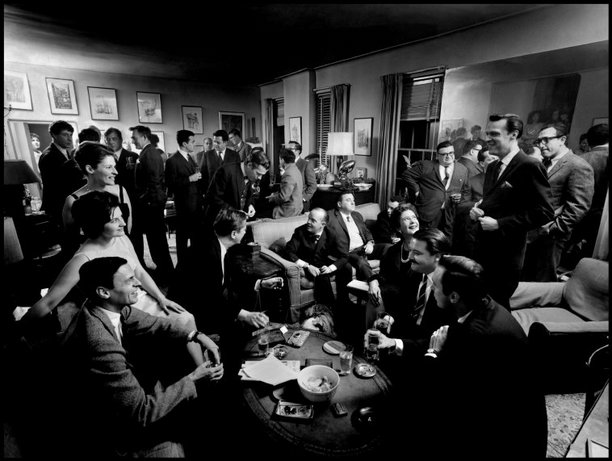
“The ignorance and isolation of most women mean that they are incapable of making conversation: most of their communication with their spouses is a continuation of the power struggle.  The result is that when wives come along to dinner parties they pervert  civilized conversation about real issues into personal quarrels.  The number of hostesses who wish they did not have to invite wives is legion.”

The Female Eunuch by the renowned feminist, Germaine Greer, 1971

Lost in Translation – The Grattan Massacre of 1854

Conquering Bear was a Brule Sioux leader who in the summer of 1854 was living among bands of Minniconjou and Oglala Sioux eight miles east of the Fort Laramie military post, located in what would become Wyoming territory over a decade later.

Fort Laramie (formerly Fort John) was purchased by the U.S. Army for $4,000 only five years earlier. The first garrison was comprised of two companies of Mounted Riflemen and one company of the 6th Infantry.

Two years prior to the Fort’s purchase, Brigham Young had lead the first Mormon emigrants through Fort Laramie on his way to Zion — the valley of the Great Salt Lake.

Mormons were making a steady stream through the area by early August of 1854 and one day a Mormon cow wandered into Conquering Bear’s camp and a Minniconjou warrior by the name of High Forehead killed the cow. Even though the cow was said to be lame, when the Mormon owner of the cow reached Fort Laramie, he complained.

The young Army Lieutenant stationed at Fort Laramie, John Grattan, sent for Conquering Bear and demanded satisfaction. Conquering Bear offered a good Indian pony in exchange for the lame Mormon cow. But, Lieutenant Grattan demanded that High Forehead be delivered to Fort Laramie. Through what was apparently an unskilled or possibly disgruntled translator named Wyuse, Conquering Bear tried to explain that he, a Brule, had no authority whatsoever over High Forehead, a Minniconjou. He was just living in the same camp.

Not only did this important subtlety get lost in translation, even worse, Conquering Bear came across as arrogant through misinterpretation of his motives as he simply left the fort and went back to his camp. In reality, by all Sioux accounts, Conquering Bear was very respectful to Grattan and did his best to explain that the Sioux didn’t have the same reporting structure the U.S. Army used to manage their people. He simply had no right to tell High Forehead what to do.

Eager for action and angry at Conquering Bear’s perceived slight toward him, Lieutenant Grattan organized a troop of 31 soldiers, hitched up some mules to a cannon, and headed for the Sioux camp. When the soldiers arrived, High Forehead refused to be arrested, Grattan fired off his cannon, wounding Conquering Bear, and High Forehead promptly shot and killed Grattan.

The massacre commenced and all thirty-one of Grattan’s men were killed on the spot. Apparently, the Sioux took their time killing Wyuse. This bad translator, whether through ommission or commission, caused a lot of trouble for everyone in the camp, as well as the eventual death of a popular leader — Conquering Bear.

Orphaned on the Oregon Trail

I’m constantly impressed by what people are able to endure and accomplish when faced with adversity. Especially children and young adults. And, some of my favorite stories about human potential and resiliency come from people who migrated West across the American Great Plains back in the mid-nineteenth-century.

I’ve read varying accounts from two books and an old immigrant’s journal describing the experiences of a fourteen-year-old girl by the name of Catherine Sager. The following is a brief account I’ve pieced together about Catherine and her family, along with some observations of my own.

Catherine Sager was one of seven children who left St. Joseph, Missouri with their parents bound for Oregon Country in the Spring of 1844. Thankfully, Catherine kept a journal as she traveled along the famous Oregon Trail.

One August day, Catherine was jumping in and out of the Sager wagon as it was moving and her dress got tangled on the wagon axle. She was thrown under the wagon wheel and her leg was badly fractured. She was forced to stay in the wagon for the remainder of the long trip, which might have been the reason she had so much time to write in her journal.

Just east of Green River in what is now Southwest Wyoming, Catherine’s father became ill and died. Catherine’s journal doesn’t say what type of sickness her father succumbed to, but does describe how distraught he was about the condition in which he was about to leave his family. He was buried on the banks of the Green River.

Various members of the expedition did their best to help the Sager family, but others apparently took advantage of Mrs. Sager a couple of times before she also became sick.  Catherine wrote in her journal, “The night and mornings were very cold, and she took cold from the exposure unavoidably. With camp fever and a sore mouth, she fought bravely against fate for the sake of her children, but she was taken delirious soon after reaching Fort Bridger, and was bed-fast.”

At fourteen, Catherine was likely the oldest of the Sager children, and the youngest was less than a year old. Only twenty-six days after Catherine’s father died, her mother also passed away, leaving the children to be taken care of by strangers who were mostly ill-prepared to even take care of their own.

Catherine went on to write that “a woman from the train” took the baby as her own and the rest were “adopted by the company” that was “ready to do us any possible favor.” When the emigrants reached “Whitman’s mission,” they left the Sager children behind.

Whitman’s mission was located at Waiilatpu on the Walla Walla River in what is now Washington State. Waiilatpu is a Nez Perce word meaning, “people of the place of the rye grass.” Dr. Marcus and Narcissa Whitman had established their mission in 1836 to “bring Christianity to the Cayuse Indians.”

The Whitman mission struggled a great deal between that Spring of 1844 and 1847. By the time the Sager children arrived, the very first large groups of emigrants bound for Oregon country had already been passing through for two years.

Those emigrants brought measles and other diseases with them; the same diseases that might very well have caused the deaths of Catherine Sager’s parents. The Cayuse certainly had no resistance to the various diseases the Oregon-bound emigrants brought along with them and began to resent the Whitmans, even though the helpful work they did for the Cayuse was well documented.

By 1847 half of the Cayuse tribe had died of the measles. Dr. Whitman’s medicine helped the white children, but did nothing for the children of the Cayuse. Many Cayuse believed they were being poisoned so there would be more room available for the whites.

On November 29, 1847 a group of Cayuse attacked the Whitman mission and killed Dr. and Mrs. Whitman along with a dozen other people living with them.

Catherine Sager and here siblings were taken captive during the Cayuse attack, along with approximately 60 other people.

Although all the captives were said to have been safely ransomed about a month later by employees of the Hudson Bay Company, one can only imagine how the Sager children measured loss and sacrifice as they went on with the rest of their lives.

Dad’s garden bench

My Dad was a gifted carpenter.  He loved working with wood.  The same way a business consultant shares new ideas with his clients or a contemplative thinks of new approaches to the subject of God, my Dad practiced woodworking.

I’m lucky enough to enjoy one of his first creations in my house.  It’s a bookcase he built in high-school wood shop when he was about 15 years old.  It’s all cherry wood with a glossy finish.  He used no nails, only glue and wood dowels.  He made it in 1945.  Sixty-five years later it is as solid as anything in my house.

One of the last things Dad made for me is what I call a garden bench.  It’s a simple thing and not really made for an adult to sit on.  I remember him telling me it would be good for potted plants or garden tools and such.  He had someone paint the backrest to look like bird houses.  It was really cute and we enjoyed it on the back porch of our previous house for years.

Unlike Dad’s cherry wood bookcase, his garden bench wasn’t built to last sixty-five years.  I obviously love it just as much as anything else he built, but it’s been slowly falling apart while sitting in my garage.  For over a decade it’s been serving the very purpose he suggested to me; a holding place for garden equipment, pots, and other junk I’ve stacked on top of it.

I’ve been doing a massive clean-up and reorganization of my garage the past few weekends, reclaiming it as usable space rather than treating it like a three car trash hole.  As I was separating stuff I intend to keep from the trash, I eventually came to Dad’s garden bench.  Looking it over made me a little melancholy at first.  That’s understandable.  But, thankfully I haven’t mourned a great deal over my Dad’s passing.  When I dwell on my Dad’s memory for more than even a few seconds, all I can do is smile.

It was the same with his garden bench.  At first I wondered what I was going to do with it, like it was any other object taking up space.  Then I stopped and thought about how this was one of his last woodworking projects he gave me.  This thing was an example of Dad’s “wood practice”.  Throwing it in the trash wasn’t an option.  But, leaving it stuck in the garage like some useless thing didn’t seem right anymore.  Plus, it’s falling apart.  The wood he used for this bench apparently wasn’t as hard as cherry wood. And, the screws he used to put it together aren’t holding anymore.  It’s beginning to deteriorate.

But, that’s ok.  I’ve learned the value of accepting that things fall apart.  Things, people, ideas — nothing lasts forever.  I’m grateful I’ve lived long enough to understand that transience and impermanence are two of only a handful of concepts which are real and that chronic frustration or suffering comes from grasping and clinging onto things which are impermanent and soon to be gone.

I spent a few minutes being with Dad’s garden bench, observing the details, thinking about what went through his mind when he decided to add some of the small touches he did.  Some are practical and others are fancy.  He liked to do that…add something subtle, maybe a unique design element or the implementation of a practical component in a snazzy way.

I thought about how excited he must have been when he finished that bench and loaded it in the back of his pickup truck to bring it to us.  I can’t imagine anything more fun than building something in my shop and presenting it to one of my grown kids.  I intend to do that one day and it’s the primary reason I’ve been taking back control over my garage, to reinstate one corner as a shop I started many years ago.

After a few minutes of this nostalgic reminiscence  I knew exactly what I was going to do with Dad’s garden bench.  I decided to remove it from that stuffy garage so it could enjoy its final days in the fresh air and canopied sunlight of the forest.  I searched for just the right place and found it at the end of a natural path.  White-tail deer live on our place and I believe the path I found is theirs.  I placed Dad’s garden bench at the end of a lane that I hope is busy with animals when we’re not around.  It’s under a nice, big tree.  As I placed it there and had a few more thoughts about Dad and the things he enjoyed, I smiled at this final thought as I hiked back to the house; wouldn’t it be nice if one of his great-grandchildren discovered his bench under this tree in a few years and decided to have a nice sit.

Or, it might be nothing more than a pile of painted wood by then, and that’s ok, too.

Matryoshka dolls, Russian culture and Communism

The 19th century Russian artist Sergei Malyutin sketched the concept then painted the first nesting doll which V. Zveydochin had turned on a wood lathe. This first set still survives and is on permanent display in the Zagorsk Museum of Toys.

The nesting sets are turned of seasoned Linden wood. They are known as Matryoshka dolls. A Matryoshka is the most honored and revered elderly woman of a village.

In Russia, the dolls are given as gifts to children.  In the rest of the world, the dolls are collected by adults and children alike.  Some dolls are blond and others are dark-haired, depending on which region’s inhabitants they’re modeled after.

The doll on my bookshelf is from Semyonov, Russia.

The picture of the Matryoshka doll with the teeth is actually a poster seen by a buddy of mine a few days ago while on a vacation trip to Prague.

It’s interesting to me how such a lovely artistic symbol, honoring village elders and representing a grand cultural diversity, is perceived as a symbol of evil by an formerly-occupied society.

It’s a good study in perspective.  I suppose cultural icons can represent bliss and tragedy both at the same time depending on who has done what to whom.