The watercourse way

The anarchic, individualistic emphasis of Taoism, which made a Taoist organization something of a contradiction in terms, meant that the Chinese expressed in private the sentiments which other civilized societies incorporated into organized religion; and this may explain how Chinese government was able to maintain itself for more than two millennia without more than sporadic support from a public and emotionally powerful religion.

~ William McNeill

One big happening

When you see things in your world – a part of nature, another aspect of life – that appear separate from you, just look at them deeply. Look into them. True separation, from anyone or anything, is simply not possible.

~ Neale Donald Walsch

Saunter in our Holy Land

Hiking – I don’t like either the word or the thing. People ought to saunter in the mountains – not hike! Do you know the origin of that word ‘saunter?’ It’s a beautiful word.

Away back in the Middle Ages people used to go on pilgrimages to the Holy Land, and when people in the villages through which they passed asked where they were going, they would reply, “A la sainte terre,’ ‘To the Holy Land.’

And so they became known as sainte-terre-ers or saunterers. Now these mountains are our Holy Land, and we ought to saunter through them reverently, not ‘hike’ through them.

~ John Muir

Upadana, desire and belief

It’s been said that desire (wanting or not wanting) is the source of all frustration and suffering.  I’ve thought quite a bit about this and I believe it’s true.  From the most insignificant to the most horrible thing I can imagine, the disconnect between what “I want” and “what is” can be accurately described as the source of suffering.  If one closes that gap and discontinues wanting, extinguishing the desire, the frustration and suffering cease to exist.

There’s a cool Sanskrit word for desire. Upadana.  Interestingly enough, upadana is also a word for “fuel.” Back in ancient times upadana was apparently the word for firewood as well as the cause for suffering.

So, I guess you can say that desire is the firewood that keeps our suffering burning.

Beliefs are a form of desire. Beliefs are illusory ideas we use to offset or bolster against the realities of impermanence and interdependence. We want to think we’re solidly independent, but we’re not. Our existence relies on other people as well as all natural and living things.

By the same token, we want to think we’ll last forever.  We certainly behave like we will most of the time even though deep down we know we won’t.  We continue to pretend that things, people and institutions will last forever and act perplexed, indignant, angry or sad when they don’t.  All of these emotions and others emerge out of that same gap between our self-delusion and reality. The bigger the gap, the bigger the load of upadana.

Absolutely no physical thing in this world is permanent. That’s reality. And, our beliefs, regardless of their origin, if held on to long enough will eventually contradict that reality. Whereas, if we perceive things as they are and as they happen without partiality, our beliefs will disappear like wisps of smoke.

Indeed, desires and beliefs are no more than reflections of dissipating clouds in mirrors of perception. Ideas and feelings passing through our mind which we use to describe the behavior of our ego. They’re related in that they’re both delusions, pushing and tugging against “what is.”

But, all too often we attach to them and treat them as if they were solid, irrefutable facts, sadly acting upon them with unacceptable behaviors, ranging from eating too many cookies to invading countries.

Upadana. Fuel which can keep us warm on a cold night or burn us up alive, completely consuming us until there is nothing left.

~ Scott Kinnaird

Casting out the money changers

In the beginning the church was a fellowship of men and women centered on the living Christ. Then the church moved to Greece, where it became a philosophy. Then it moved to Rome, where it became an institution. Next, it moved to Europe, where it became a culture. And, finally, it moved to America, where it became an enterprise.

– Richard Halverson, Former Chaplain of the U.S. Senate

The difference between observation and judgement

This farmer had only one horse, and one day the horse ran away. The neighbors came to condole over his terrible loss. The farmer said, “What makes you think it is so terrible?”

A month later, the horse came home–this time bringing with her two beautiful wild horses. The neighbors became excited at the farmer’s good fortune. Such lovely strong horses! The farmer said, “What makes you think this is good fortune?”

The farmer’s son was thrown from one of the wild horses and broke his leg. All the neighbors were very distressed. Such bad luck! The farmer said, “What makes you think it is bad?”

A war came, and every able-bodied man was conscripted and sent into battle. Only the farmer’s son, because he had a broken leg, remained. The neighbors congratulated the farmer. “What makes you think this is good?” said the farmer.

~ a very old Taoist story

Be the carrot

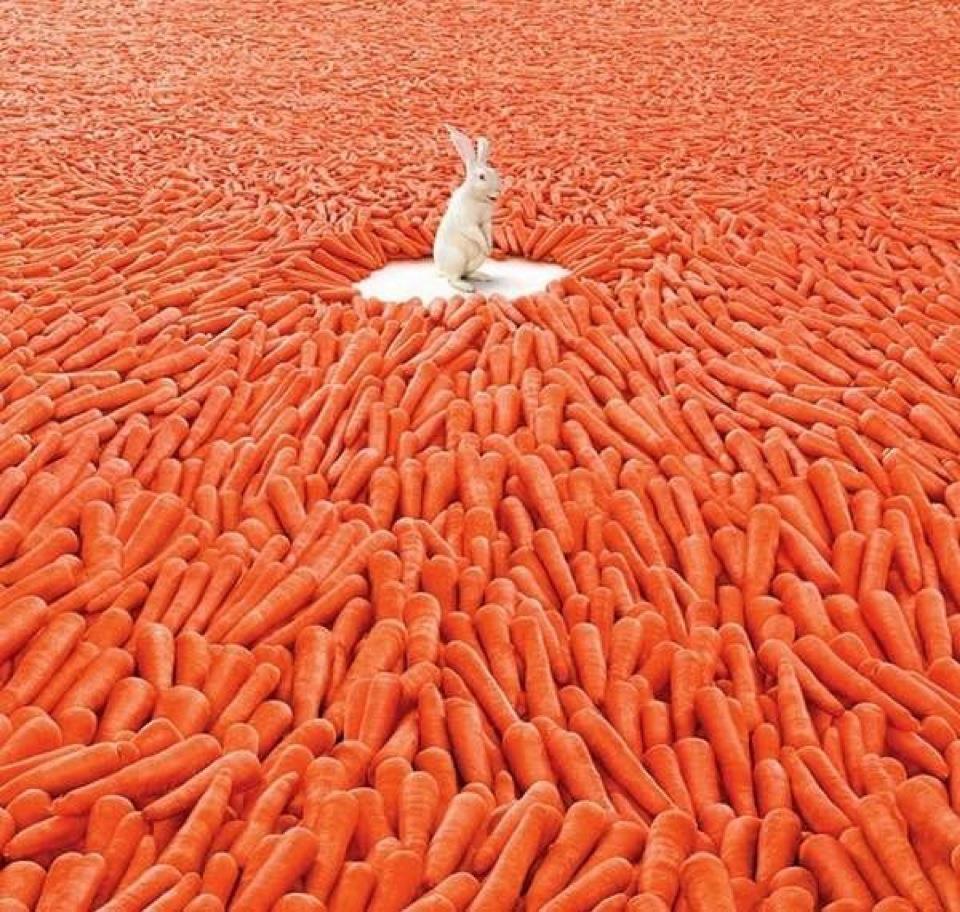
This photo is Rabbit Heaven and is a great metaphor for heaven, in general. The first time I saw this photo, I absolutely loved it. It reminded me of people and their relationship with and concept of enlightenment, nirvana, heaven, etc.. We’re literally swimming in it. We ARE IT. Yet, we create this false bubble of delusion in which we reside to keep it at arm’s length.

Extending the metaphor, many refer to that bubble or that rabbit’s circle as the “ego”. While we as rabbits sit within a sea of carrots, half of us chase carrots and the other half chase relief from chasing carrots. When in reality, the carrots surround us and there’s nothing to chase. All we have to do is be still and “be carrots.”

~ Scott Kinnaird